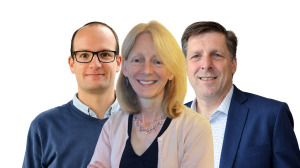
Brian Kennedy, Joris Deelen, Lynne Cox
Brian Kennedy, Buck Institute
Dr. Kennedy earned his PhD from the Massachusetts Institute of Technology and is well known for his work during his graduate studies with Leonard Guarente, PhD, which led to the discovery that sirtuins (SIR2) modulate aging. He performed postdoctoral studies at the MGH Cancer Center associated with Harvard Medical School. From 2001 to 2010, he held a faculty position at the University of Washington. He was the president and CEO of the Buck Institute from 2010 to 2016 and remains a professor at the Institute. In addition, he is a visiting professor in medicine and healthy aging at National University Singapore, an adjunct professor in the Davis School of Gerontology at the University of Southern California, and an affiliate professor in the Department of Biochemistry at the University of Washington. Dr. Kennedy has published more than 160 papers in prestigious journals, including Cell, Science, and Nature. He serves as co-editor-in-chief of Aging Cell and is on the editorial board of a number of other scientific journals. He also routinely provides lectures to the public and is active in writing opinion pieces on aging in public media outlets around the world. More recently, Dr. Kennedy has become active in the biotechnology and pharmaceutical arena, serving as a consultant for several companies. He is currently on the board of directors of three companies, including acting as board chair of Mt. Tam Pharmaceuticals. He has also completed research projects for several biotechnology companies.
Joris Deelen, Max Planck Institute for Aeging
Joris Deelen is leading the research group on Genetics and Biomarkers of Human Aeging at the Max Planck Institute for Aeging Research. The group studies the genetic mechanisms underlying healthy ageing in humans by investigating the effect of genetic variants that are unique to long-lived families on the functioning of pathways implicated in ageing and/or age-related diseases. Moreover, they try to identify and validate biomarkers of healthy ageing using data from large-scale international collaborations of human studies.
Lynne Cox, Oxford
University Lynne Cox is the George Moody Fellow and Tutor in Biochemistry at Oriel at the University of Oxford. Her lab studies the molecular basis of human ageing, with the aim of reducing the morbidity and frailty associated with old age. Her lab studies progeroid Werner’s syndrome (WS), where cell senescence and early onset of many age-related symptoms in the patients result from loss of a single protein, the WRN helicase/exonuclease that is involved in DNA replication, recombination and repair. The lab has shown that DNA replication is aberrant in human cells when WRN protein is mutated. Her research interests lie in DNA, how it is copied accurately and how this is coordinated within the cell division cycle.